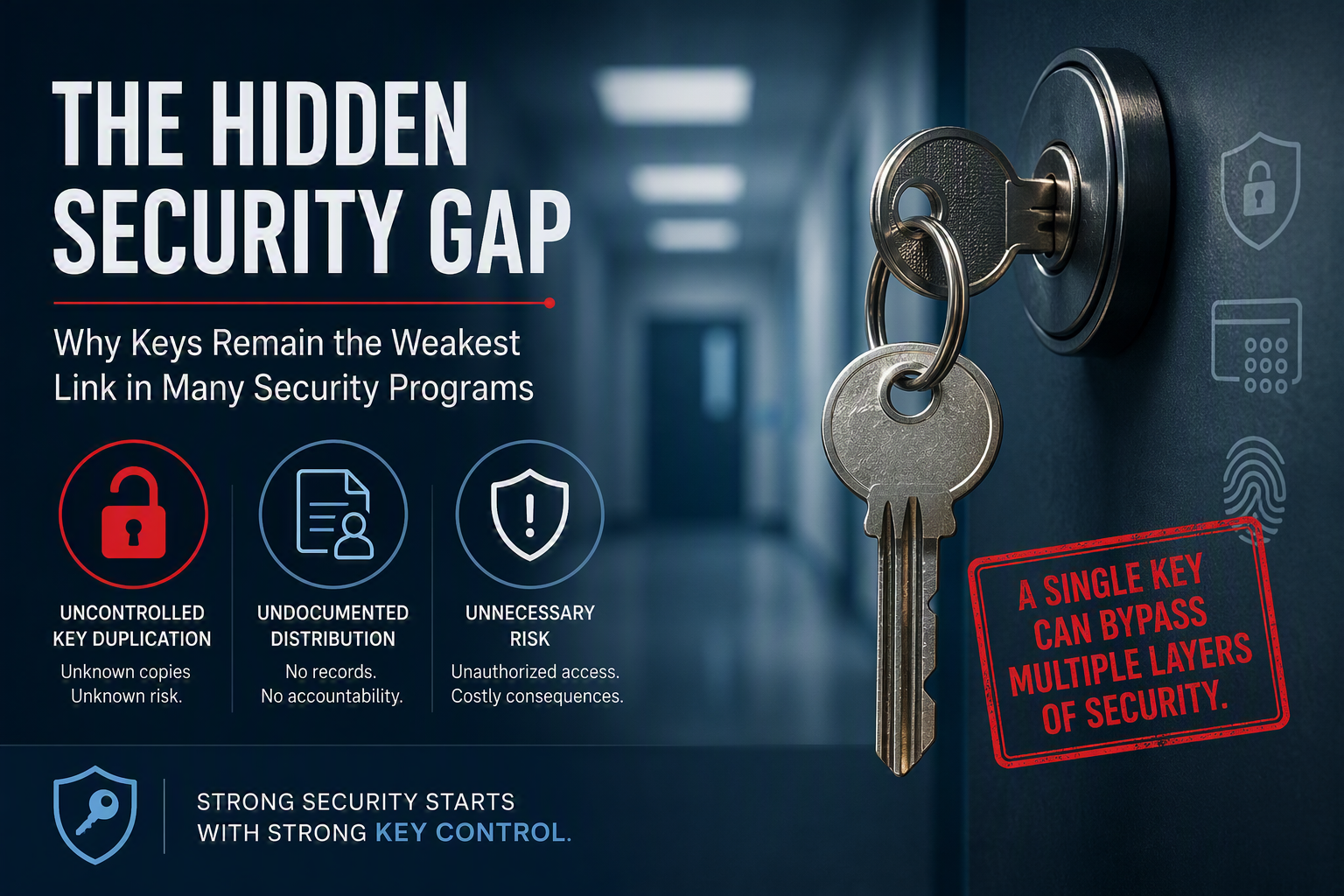
The Hidden Security Gap: Why Keys Remain the Weakest Link in Many Security Programs
For many organizations, keys are viewed as a simple operational necessity rather than a critical security asset. As a result, key management processes are frequently outdated, undocumented, or inconsistently enforced.
When security leaders evaluate organizational risk, discussions often focus on cyber threats, credential theft, network vulnerabilities, and electronic access control systems. These are all valid concerns. However, there is an often-overlooked vulnerability lurking in countless facilities, campuses, healthcare institutions, schools, and commercial buildings: poorly controlled mechanical keys.
For many organizations, keys are viewed as a simple operational necessity rather than a critical security asset. As a result, key management processes are frequently outdated, undocumented, or inconsistently enforced. This creates a hidden security gap that can expose facilities to theft, unauthorized access, compliance issues, and significant financial losses.
The False Sense of Security
Modern organizations routinely invest in advanced technologies to secure their environments. Video surveillance systems, biometric readers, card access solutions, and cybersecurity platforms are designed to protect assets and people while reducing risk.
However, even facilities with sophisticated electronic security systems often rely on mechanical keys for critical access points, including:
- Server rooms
- Data centers
- Utility closets
- Pharmaceutical storage areas
- Equipment rooms
- Emergency exits
- Interior offices
- Restricted storage areas
A single undocumented key can effectively bypass layers of security technology. If an individual possesses a key that management doesn't know exists, access control records, alarms, and audit trails become significantly less effective.
The Risks of Uncontrolled Key Duplication
One of the most common weaknesses in physical security programs is uncontrolled key duplication.
Standard keys can often be copied quickly and inexpensively at local hardware stores, locksmith shops, or self-service kiosks. In organizations without restricted key systems or formal authorization procedures, there may be little visibility into who possesses copies of important keys.
This lack of control creates several risks:
Unauthorized Access
Former employees, contractors, vendors, or tenants may retain keys long after they no longer require access. If duplicate keys have been made without approval, security teams may have no way of knowing how many active keys are in circulation.
Increased Internal Threats
Most organizations focus heavily on external threats, but insider risks remain a significant concern. Uncontrolled keys provide opportunities for unauthorized entry without triggering the alerts commonly associated with electronic credential misuse.
Costly Rekeying Projects
When a key is lost or unaccounted for, organizations often face difficult decisions. If there is uncertainty about who may have access, entire facilities or departments may require rekeying. These projects can be expensive, disruptive, and time-consuming.
Compliance and Audit Challenges
Industries with regulatory requirements often need to demonstrate control over physical access to sensitive areas. Incomplete key records and undocumented duplication can create gaps during audits and potentially expose organizations to compliance concerns.
The Danger of Undocumented Key Distribution
The challenge is not limited to key duplication. Many organizations also struggle with documenting key issuance, returns, and transfers.
Consider a common scenario:
A facility manager issues a key to an employee. The employee changes departments and hands the key to a colleague. That colleague eventually leaves the company and passes the key to another team member. Years later, nobody knows who originally received the key or how many people have had access to it.
Without a centralized key management process, organizations lose accountability. Security leaders may be unable to answer fundamental questions such as:
- Who currently possesses this key?
- When was it issued?
- Who authorized access?
- Has it ever been duplicated?
- Has it been returned?
If these questions cannot be answered quickly, the organization faces unnecessary risk.
Why Mechanical Key Control Still Matters
Some organizations assume electronic access control systems will eventually eliminate the need for keys. While electronic solutions continue to expand, mechanical keys remain essential components of most security infrastructures.
Mechanical locks often serve as:
- Backup access methods during power failures
- Protection for areas without electronic systems
- Security for remote facilities
- Access control for cabinets, enclosures, and equipment
- Layers of protection within high-security environments
Because keys continue to play a critical role, they should be managed with the same rigor applied to access cards, cybersecurity credentials, and other sensitive assets.
Building a Stronger Key Control Program
Addressing key management weaknesses does not require a complete overhaul of an organization's security strategy. Instead, security leaders should focus on establishing accountability and visibility.
Key best practices include:
Implement Restricted Key Systems
Restricted keyways limit unauthorized duplication and help ensure that only authorized parties can produce additional keys.
Maintain Accurate Key Records
Organizations should document every key, lock, user, issuance date, return date, and authorization approval. Centralized recordkeeping improves accountability and audit readiness. One solution we recommend is SimpleK software, which offers a free trial version.
Establish Formal Key Policies
Policies should define who can request keys, who can approve issuance, how lost keys are reported, and what procedures are followed when employees leave the organization. Here are two really helpful documents for key policies.
1) This "Key Control Policies" document was put together by Medeco, ASSA ABLOY ACCENTRA, Corbin Russwin, and SARGENT.
2) The "Medeco Key Control Guide" is also a great document.
Conduct Regular Audits
Periodic key audits help verify that assigned keys are still in the possession of authorized individuals and that records remain accurate.
Integrate Physical Security Management
Mechanical key control should be treated as an integral part of the overall security strategy, not as a separate administrative task.
Security Is Only as Strong as Its Weakest Link
Organizations spend significant resources protecting digital identities, managing electronic credentials, and strengthening cyber defenses. Yet a single uncontrolled key can provide direct access to critical spaces and sensitive assets.
The most effective security programs recognize that physical and electronic security must work together. By implementing proper key control procedures, restricting duplication, and maintaining accurate documentation, organizations can close a frequently overlooked security gap and strengthen their overall risk posture.
In an era of increasingly sophisticated threats, success often comes down to mastering the fundamentals. And few fundamentals are more important, or more frequently neglected, than knowing who has your keys.