How Door Hardware Provides Value to Data Centers
Door hardware is a critical part of secure and efficient data center operations. Discover how it strengthens access control, supports safe egress, and helps reduce energy use.
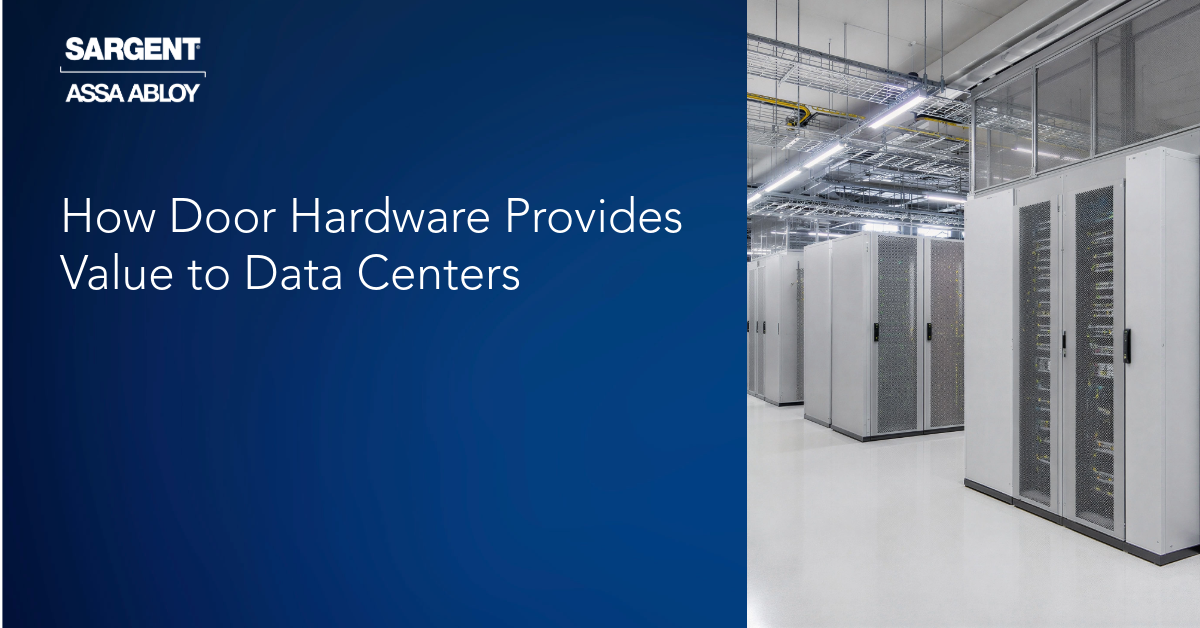
Door hardware may seem like a small detail in a data center, but it’s a critical asset that is integral to its operations. These facilities have high-stakes requirements for access control, egress, and energy that doors are uniquely suited to fulfill. The right hardware on every opening will contribute to a data center running smoothly and securely.
How Is Door Security Different At A Data Center?
Data centers have a higher door density than the average commercial building. Because these properties prioritize Crime Prevention Through Environmental Design (CPTED), doors are an essential strategy to deter unauthorized entry. Up to 90% of data center openings are paired with electronic access control systems. By contrast, a typical office might reinforce only 5–10% of its doors.
Security
Access control doesn’t stop at the exterior of a data center. Interior doors must also restrict movement throughout the building. Card readers and biometrics are a standard measure to verify the identity and permissions of each individual, from site staff and service technicians to clients and owners. These security layers have a singular purpose – to protect confidential and proprietary data.
Access control measures are even more pronounced at colocations, which provide an individual vault to each company’s servers and hardware. Unlike a shared warehouse with open aisles, every vault has its own corridor that controls traffic. As a result, colocations could have four times the door density over an enterprise data center with a single client.
To ensure every opening offers maximum security, look for these hardware qualities:
· Grade 1 rating
· Durable materials
· Tamper-resistant design
Encrypted electronic communication is also imperative to counter both physical and cyberattacks. A standard like OSDP (Open Supervised Device Protocol) offers two levels of protection. Thanks to its supervised status, it constantly checks if wires and the device itself is working. Its 128-bit AES encryption can also deter hacking attempts like man-in-the-middle attacks.
Egress
Data centers commonly specify oversized doors to accommodate the size of equipment. This allows technicians to maneuver server racks and cabinets with enough clearance to avoid damage. Since these heavy-duty openings are routinely steel stiffened and between 9–12 feet tall, they require Grade 1 hardware.
Hands-free operation is another way that door hardware can support heavy cart traffic. A low-energy operator will help facilitate passage by holding open the door for a brief window and then returning it to close. Motorized electric latch retraction can also remotely engage the locking mechanism.
In the event of an emergency, door devices must fulfill fire code too. Electromechanical solutions frequently have positive latching, which ensures a door remains closed even when subjected to heat and smoke. This is an important safeguard considering the risk of electrical and lithium-ion battery fires inherent to data centers.
Operations
A data center also needs doors that actively contribute to operational goals, especially since energy reduction is a priority to offset high cooling loads. Doors that consistently close, latch, and seal help limit thermal leakage. By addressing this source of energy waste, doors can quantifiably help data centers manage utility costs.
To further help data centers account for every kilowatt, incorporate door solutions with a low energy profile. These include electrified mortise locks and exit devices with minimal power needs as well as integrated wired locks with intelligent power management. These solutions not only support energy efficiency but help data centers comply with regulatory grid caps.
SARGENT has a suite of door hardware options that can be tied into a single offering. Contact our team to learn more.