Securing Access in a Changing Landscape
As security demands grow, organizations are moving beyond legacy access models to gain centralized control, real-time visibility, and greater resilience.

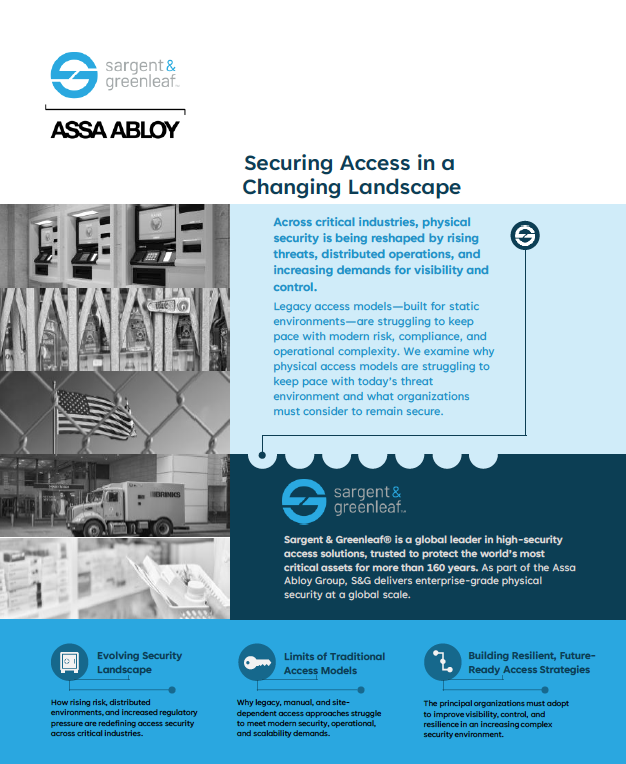
Across critical industries, physical security is being reshaped by rising threats, distributed operations, and increasing demands for visibility and control.
Legacy access models—built for static environments—are struggling to keep pace with modern risk, compliance, and operational complexity. In this article, we examine:
- Evolving Security Landscape: How rising risk, distributed environments, and increased regulatory pressure are redefining access security across critical industries.
- Limits of Traditional Access Models: Why legacy, manual, and site-dependent access approaches struggle to meet modern security, operational, and scalability demands.
- Building Resilient, Future-Ready Access Strategies: The principal organizations must adopt to improve visibility, control, and resilience in an increasing complex security environment.
To view the full formatted version, click here.
The Turning Point: Legacy Access to Modern Security
Across today’s critical industries, physical security is being reshaped by evolving threats, expanding operational footprints, and rising demands for visibility, control, and resilience. Organizations are navigating a convergence of physical and digital risk while balancing efficiency, compliance, and workforce challenges — exposing the limitations of traditional access approaches built for more static environments. As expectations for accountability and uptime grow, security leaders must rethink how access is managed to reduce friction, strengthen protection, and support long-term scalability. Here, we explore the forces driving this shift and outline why legacy access models are struggling to meet modern demands — setting the stage for a new generation of secure, adaptable access strategies.
The Cost of Legacy Access Models
Many organizations continue to rely on access control systems that require manual programming, physical credentials, or localized administration. While familiar, these approaches introduce hidden costs and risks.
- Operational Inefficiency: On-site programming and credential changes require time, coordination, and skilled labor.
- Limited Visibility: Fragmented systems make it difficult to understand who has access, when, and where—especially across multiple sites.
- Delayed Response: When access must be modified urgently, physical presence is often required, slowing response times.
- Increased Risk Exposure: Lost, shared, or outdated credentials can remain active longer than intended.
As organizations grow and operations become more dynamic, these limitations compound, creating friction that impacts both security and performance.
“Legacy access systems worked when everything was local and predictable, but today we’re managing sites across multiple locations with growing security expectations. The biggest challenge isn’t just access—it’s visibility. If we can’t see and control who has access in real time, we’re already behind.”
— Industry ATM Network Owner
A Cross-Industry Shift in Expectations
Across sectors, expectations for physical security are evolving. Leaders are no longer only asking “Is it secure?” They are now also asking:
- Can access be managed centrally across all locations?
- Can permissions be granted, adjusted, or revoked quickly?
- Is there clear accountability and auditability?
- Can systems adapt as operations change?
- Does security support uptime and operational continuity?
This shift reflects broader trends already seen in IT, logistics, and facilities management: centralized oversight, real-time insight, and reduced reliance on manual processes. Physical security is beginning to follow the same trajectory.
Industries at the Inflection Point
- Financial Services & Cash Management: High-value assets, regulatory requirements, and distributed networks demand both resilience and oversight.
- Retail & Commercial Environments: From high-volume locations to specialty operations, retailers require secure access without disrupting daily operations.
- Transportation & Logistics: Assets in motion and remote locations introduce complexity that traditional access models struggle to support.
- Government & Critical Infrastructure: Compliance, accountability, and continuity are paramount, often under heightened threat conditions.
- Healthcare & Medical Facilities: Controlled access must balance security with efficiency, especially in environments where delays can have real consequences.
Despite their differences, these sectors share a common need: access control that is strong, adaptable, and operationally efficient.
The Principles of Modern Physical Security
Rather than focusing on specific technologies, organizations are aligning around a set of guiding principles that define the future of secure access:
- Security Without Compromise: Strength, durability, and resistance remain non-negotiable.
- Centralized Oversight: Visibility and control across all locations from a single point.
- Operational Simplicity: Reduced reliance on manual processes and on-site intervention.
- Scalability: Systems that grow and adapt with the organization.
- Auditability & Accountability: Clear records of access activity to support compliance and governance.
- Future Readiness: Architectures designed to evolve as threats, regulations, and operations change.
These principles are shaping how leading organizations evaluate and modernize their security infrastructure.
Preparing for What’s Next
As physical and digital environments continue to converge, access control will play a central role in operational resilience. Organizations that proactively assess and modernize their security strategies will be better positioned to reduce risk, control costs, and maintain trust. With more than 160 years of experience protecting the world’s most critical assets, Sargent & Greenleaf continues to study these shifts closely—working alongside global partners and customers to understand how secure access must evolve. The next era of physical security is taking shape. Those who prepare now will define the standard moving forward.
To explore how Sargent & Greenleaf is preparing the industry for a cloud-enabled future, visit SargentandGreenleaf.com.
Or, if you're interested in learning more about Sargent and Greenleaf solutions, get in touch with our team of experts by filling out the form below.