How Door Hardware is Mission Critical to Data Centers
Data centers demand high levels of security, efficiency, and reliability. Learn how door hardware supports critical operations at every opening.
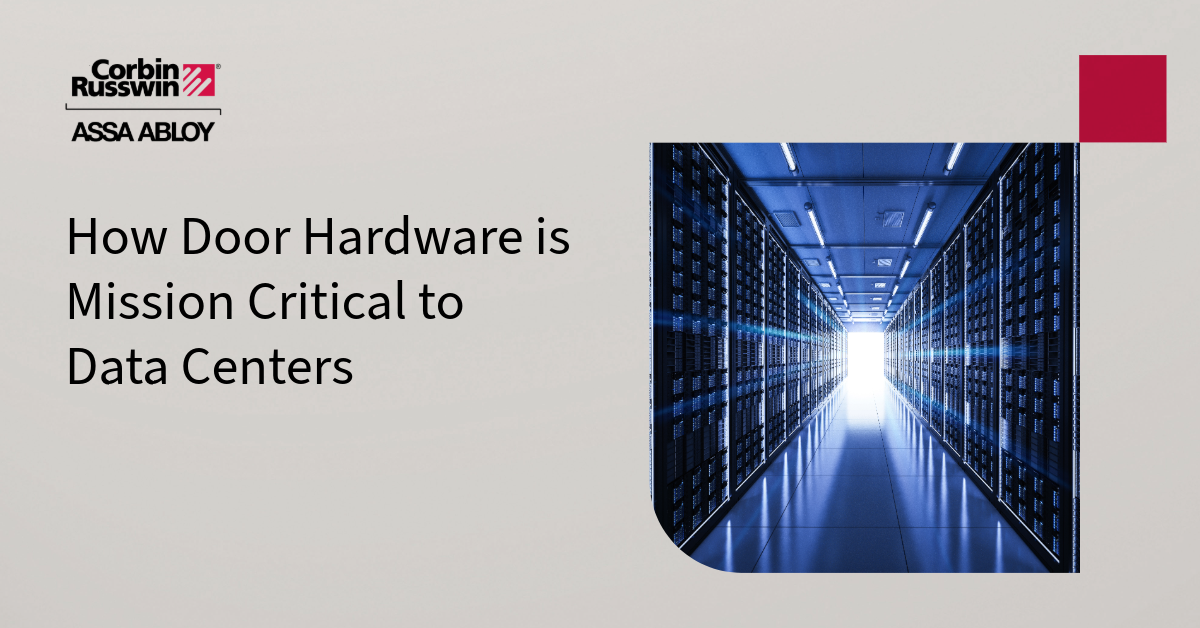
From the curb to its core, doors in a data center are integral to smooth and secure operations. Notable for their high door density, these facilities have unique concerns for access control and energy. Learn about three ways that door hardware plays an essential role at every single opening.
1) Security Measures
Access control is significantly heightened at a data center compared to a commercial development. For example, a typical office building might restrict access at 5–10% of openings, primarily concentrating on exterior entrances and server rooms. But the inverse is true with data centers – upwards of 90% of doors are equipped with electronic systems like card readers. The level of sophistication is higher, too, since biometrics are routinely present.
This is because data centers strictly adhere to the principles of Crime Prevention Through Environmental Design (CPTED). The priority is to keep people out through multiple layers of deterrents, mitigating the risk of unauthorized or forced entry. Door security is a crucial way to limit precisely how far a person is permitted into the building. Owners and developers also require solutions made with the highest quality materials, such as Grade 1 door hardware, because they offer yet another safeguard against compromised access.
Security is even tighter at a data center colocation, where every company’s servers and hardware are secured inside an individual vault. Door density is vastly higher in these facilities, sometimes quadruple over an enterprise data center, because each vault has its own designated pathway. Minimizing the possibility of unauthorized entry is paramount when data relates to HIPPA, PII (personally identifiable information), confidentiality agreements, and other proprietary information.
It also doesn’t matter that data centers are low-occupancy buildings – it is imperative that the entire entry-and-exit sequence is tightly orchestrated. Look for technology that communicates over OSDP (Open Supervised Device Protocol), the standard developed by the Security Industry Association (SIA). By continuously monitoring wiring, it offers protection against physical tampering. Its encryption can also thwart cyberattacks such as man-in-the-middle.
2) Energy Efficiency
Data centers have high cooling loads, so it is important to offset those demands by minimizing energy consumption at every given opportunity. There is a pronounced need for doors that properly close, latch, and seal to maintain thermal control. Doors that help preserve environmental conditions help ensure kilowatts are supporting business operations rather than building operations.
Also consider that data centers are typically capped by how much power they can draw from the grid, underscoring how energy efficiency has a greater regulatory priority than a commercial facility. Technology that reduces energy consumption in electrified mortise locks and exit devices as well as intelligent power management on integrated wired locks is an impactful way to reduce electricity demand.
3) Traffic and Egress
Another consideration to take into account is the size of server racks and cabinets that many data centers store. To accommodate equipment, the majority of data center doors are oversized to avoid the risk of damaging assets while being moved through the opening. Between 9–12 feet tall, these heavy-duty doors are often steel stiffened to prevent warping. This level of reinforcement needs to be paired with durable hardware equal to the task, such as Grade 1 exit devices.
Motorized electric latch retraction and low-energy operators are another good choice for data centers because they enable hands-free passage. This is ideal for the heavy cart traffic common in data centers. The operator briefly holds open the door so equipment can pass through without the worry of damage. Then the door is returned to its closed and locked state, preventing tailgating attempts.
Finally, it’s critical to have door devices that also comply with fire code. Data centers have concentrated levels of electrical components, specialty equipment, and backup power systems. They are likely to house lithium-ion backup batteries, which carry the risk of thermal runaway. Electromechanical solutions will provide positive latching in the event of an emergency.
Corbin Russwin has a suite of door hardware options that can be tied into a single offering. Contact our team to learn more.