3 Places to Use Low-Touch Door Hardware in a Commercial Building
Low-touch door hardware is an important feature that supports hygiene, accessibility, and a positive occupant experience.
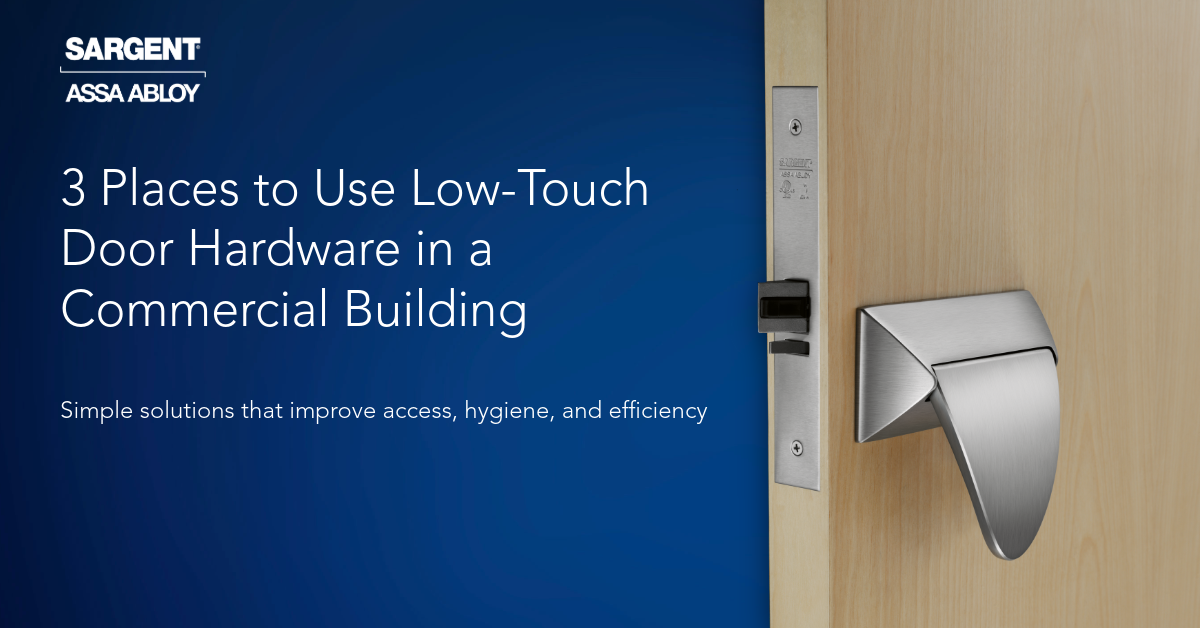
Can a single piece of door hardware satisfy hygiene, accessibility, security, and code compliance? Low-touch openings are a great way to facilitate safe and efficient movement through a building. These approaches focus on reducing hand contact by balancing hardware selection with access control, sensors, or automation. The goal is to improve circulation by allowing doors to be operated with minimal manual effort.
What Is a Low‑Touch Door Opening?
A low‑touch door opening is designed to reduce the need for direct hand contact during entry, passage, or exit. Instead of relying solely on traditional levers or pushpads, these openings support hands‑optional operation through mechanical design, electrified hardware, or a combination of system components.
Low‑touch openings can be achieved in more than one way:
· Mechanical hardware shaped for forearm, elbow, or hip operation
· Electrified hardware that reduces operating force or eliminates manual latch operation
· Activation devices such as sensors or wall actuators
· Low‑energy door operators and access control systems
In some applications, a fully mechanical solution is sufficient. In others, electrified hardware such as motorized electric latch retraction (MELR) supports a higher level of automation and integration. This electromechanical solution automatically retracts the latch. It is commonly paired with mortise locks and exit devices, but can also be used with a low-energy door operator. The retraction sequence is initiated by a Knowing Act, such as a wave-to-open sensor or other wireless technologies like proximity cards.
The right solution depends on traffic volume, user needs, and how the opening functions within the building.
1) High-Traffic Doors
Door hardware is one of the highest touchpoints in a facility. Users not only handle these surfaces as they walk through the main entrance but also while navigating through the building. It doesn’t matter whether their final destination is a conference room or private office – they will encounter a number of doorways.
This is true even when a property is not open to the public. Imagine a typical school and the numerous students and staff walking its corridors multiple times a day. The same is true in a corporate setting where employees rotate between meetings, individual tasks, and breaks. Their circulation experience could be enhanced without having to touch manually operated doors.
2) Healthcare
Healthcare environments place especially high demands on doors. Infection control, accessibility, and operational efficiency all need to be considered at every opening.
Shared spaces such as corridors, waiting rooms, and treatment areas see constant use by staff, patients, and visitors. Many users may have limited mobility or use assistive devices. Low‑touch door openings reduce the physical effort required to move through these spaces while supporting cleaner workflows.
Reducing touchpoints from doors is also useful for staff-only zones like labs and clinics. In addition to needing frequent access, employees are more likely to be carrying or pushing an item that occupies their hands. Hands‑optional door operation allows continued movement without setting items down or increasing contamination risks.
The same is applicable to treatment or recovery rooms. Think of supplies that are commonly delivered, such as a medication tray, a cart of diagnostic equipment, and wheeled IV poles. Additionally, patients may need to be moved around on hospital beds or wheelchairs. Having a low-touch way to enter and exit keeps hands clean, patients transferred safely, and staff moving efficiently.
3) Restrooms and Shared Amenities
Communal spaces, especially where people need to wash their hands, carry a higher concern for germ transmission. Restrooms and shared amenities are some of the most consistently used areas in any facility. It’s beneficial to offer low-touch hardware so users can enter and exit with little or no contact.
Compare Two Options for Hands-Optional Hardware
Facilities can support low‑touch operation in different ways. The right solution depends on traffic volume, accessibility needs, and system integration requirements.
|
Hardware
Type |
Electromechanical |
Mechanical |
|
Style |
Pair with
push-pull or exit devices |
Paddle shaped;
can be mounted in multiple orientations |
|
Durability |
Designed for
robust environments ANSI/BHMA Grade
1 certified |
Smooth edges
reduce clothing snags ANSI/BHMA Grade
1 certified |
|
Operation |
Proximity
cards, key fobs, integrated door readers, wall readers, wave to open (WTO) |
Push open by bumping
with hip, elbow, or forearm. Pull closed by
sliding elbow, forearm, or wrist underneath. |
|
Compatible
with low-energy operators |
Yes |
No |
|
Rated for
fire doors |
Yes, 3 hours |
Yes, 3 hours |
|
ADA
compliant |
Yes |
Yes |
|
Retrofit ready |
Yes |
Yes |
|
Product models |
Low‑touch door openings are not about a single product or technology. They are about creating safer, more accessible environments by reducing unnecessary contact. Whether using mechanical hardware or electrified solutions, hands-optional design protects hygiene while supporting natural movement through a building.
Interested in learning how different low‑touch door technologies can work together in your facility? Get in contact with one of our experts today!
Talk to an expert about your openings